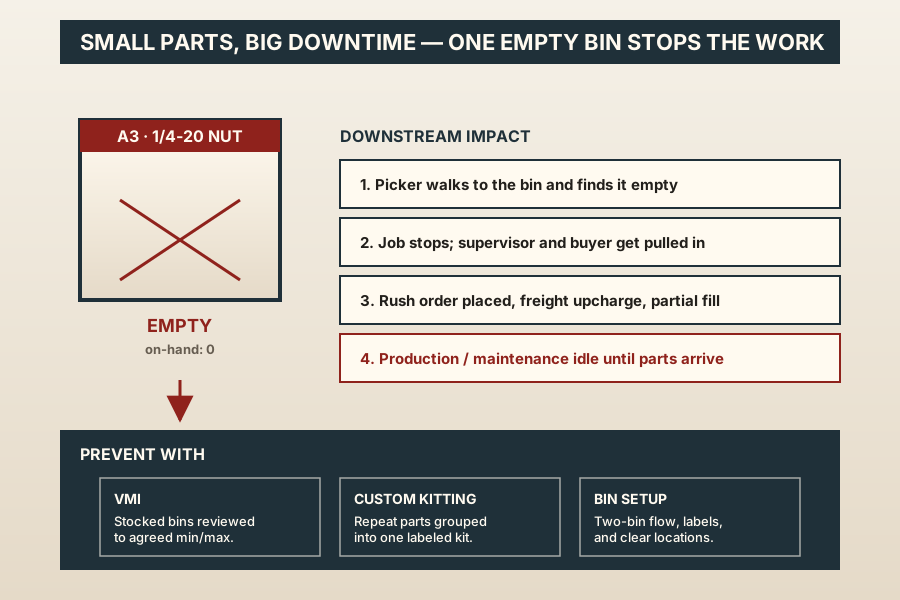
A 1/4-20 nut, a missing hose clamp, a single rivet — small parts are easy to dismiss until they are the reason a job is sitting still. In a B2B operation, a stockout on a low-cost fastener or stocked hardware item rarely costs only the price of the part. It costs the labor that is waiting, the equipment that is idle, and the rush freight to get back on schedule. This article walks through how those small stockouts turn into big downtime, and the practical steps purchasing, maintenance, and operations teams use to prevent them.
Why small parts cause outsized delays
A fastener, a clip, or a fitting is usually the last item installed before a step is complete. When that item is missing, the entire upstream investment — the staged frame, the partly assembled panel, the prepped service truck — is stuck. The cost of the part is small, but the cost of the surrounding work is not. Maintenance, assembly, and installation teams feel this every time a routine part is unavailable, because the job is already half-built when the gap is discovered.
What a stockout actually costs
The visible cost is a rush order. The hidden costs are usually larger:
- Idle labor. One or more people on the clock with nothing to do until the part arrives.
- Equipment time. A line, a press, a service bay, or a maintenance window sitting unused.
- Expediting. Premium freight, partial fills, and small-quantity pricing on a part that would normally be cheap.
- Schedule slippage. Downstream jobs reshuffle, customer commitments move, and overtime gets added later in the week.
- Quality risk. When teams substitute a near-equivalent fastener under pressure, the wrong grade, length, or finish can end up installed.
None of this shows up on the invoice for the part. It shows up on the production schedule, the maintenance backlog, and the next month's overtime line.
Where stockouts come from
The same root causes appear over and over:
- No min/max set on the bin, so the team only learns it is empty by reaching for it.
- One physical location for the active pick and the reserve, with no visual signal when the active runs out.
- Counts that drift away from reality because two SKUs share a bin, or one SKU is in two bins.
- Reorder points based on price tiers instead of usage, leaving small parts under-ordered and expensive parts over-stocked.
- A single "go-to" supplier with no defined replenishment cadence, so reorders happen only when someone notices the shortage.
Most of these are not buying problems. They are storage and process problems that show up at the bin and on the schedule.
Step 1 — set min/max on the items that actually stop work
Not every SKU needs a tight min/max. Start with the items that have stopped a job in the last quarter, the items installed on every repeat assembly, and the consumables tied to scheduled maintenance. Set a minimum that covers the lead time plus a buffer, and a maximum that reflects bin capacity and real usage. The goal is a level that triggers replenishment before the active bin is empty.
Step 2 — make the empty signal obvious
Two-bin flow is the simplest visual signal: when the active bin is empty, swap it with the reserve and the empty bin itself becomes the trigger to replenish. Color tags, KANBAN cards, and scan points do the same job. The point is that an empty bin should not require anyone to remember anything — it should walk itself into the replenishment queue.
Step 3 — give every SKU one home
Duplicate locations are the source of most "phantom" stockouts. Counts are right, the system says zero, but stock is on the floor in a bin nobody updated. A clean inventory control setup assigns one primary picking location to each SKU, with a documented reserve, so an empty active bin actually means "we are out" and not "we are out here, but maybe over there."
Step 4 — let someone else watch the shelf
For repeat-use hardware, a vendor managed inventory program moves the watching off the buyer's desk. Retmay reviews the agreed bins on a schedule, compares on-hand to min/max, and replenishes to max in one trip. The buyer sees fewer micro-orders, the floor sees fewer empty bins, and rush freight on small parts drops because the cycle is built around real usage instead of last-minute notice.
Step 5 — pre-pack the parts that move together
Many stockouts happen because a job needs four small parts at once and one is missing. Custom kitting groups the fasteners, fittings, terminals, clamps, or related hardware for a repeat job into one labeled bag, box, or package with a single kit part number. The team picks one item, not seven, and the kit cannot be partially fulfilled without somebody noticing.
Step 6 — design the storage to support all of the above
None of this works on a shelf that fights back. A correctly designed bin setup places fast-moving items at easy reach, groups related parts by family or work cell, leaves room for the reserve, and uses labels that are easy to read while picking. The right physical layout is what makes min/max, two-bin flow, and one-home-per-SKU sustainable instead of a once-a-year effort.
Step 7 — keep safety, electrical, and chemical items in the same plan
Stockouts are not only a fastener problem. Cut gloves, safety glasses, terminals, heat-shrink tubing, and maintenance chemicals interrupt jobs in the same way when they are missing. Including them in the same bin program — with their own min/max, primary location, and replenishment cadence — keeps the whole work area predictable, not just the threaded hardware aisle.
What this looks like for a B2B team
For purchasing, the result is fewer surprise reorders and fewer rush freight charges. For maintenance, it is fewer trips to the cage during a job. For production and operations, it is a schedule that moves because the small parts are already in place. None of these outcomes require a new ERP, a software rollout, or a heavy program. They start with a list of the items that have stopped work, a real min/max on each, and a clear rule for what happens when a bin is empty.
Where Retmay fits
Retmay supports these steps as a hardware distributor and as a service provider. The product side covers fasteners, fittings, hose clamps, rivets, terminals, abrasives, chemicals, safety items, and related hardware across stocked categories. The service side covers VMI, custom kitting, bin setup, and inventory control, so the bin and the part list can be set up together. A short conversation with a current parts list, a problem-item list, or a photo of a stockroom is usually enough to scope a practical first step.
Bring the list, get a plan
If small parts are stopping work more often than they should, share the items that have caused the most trouble. Retmay can review them, suggest min/max levels, identify candidates for VMI or kitting, and quote replenishment together with a bin design. The goal is a stockroom that supports the schedule instead of interrupting it.