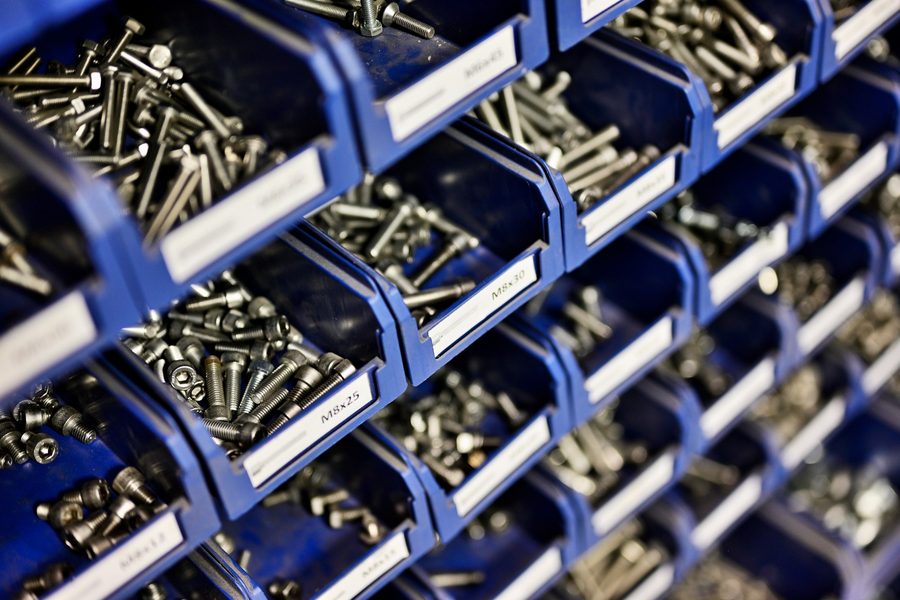
A bin setup looks like a small detail until it is the reason a job is waiting on a part. The way fasteners, fittings, hose clamps, terminals, abrasives, chemicals, and other repeat-use hardware are stored decides whether teams spend their time working or hunting. A correctly designed bin setup prevents a long list of avoidable, expensive problems before they reach the production floor, the maintenance shop, or the service truck.
Stockouts on items that are always supposed to be there
The most visible failure of a poor bin layout is running out of a routine item. When a single bin holds the entire on-hand quantity, the shortage is only discovered when someone reaches in and finds it empty. A correctly designed setup uses min/max thresholds and two-bin flow, so an empty active bin moves the reserve forward and triggers replenishment before the next picker is blocked. For repeat-use hardware tracked through vendor managed inventory, this is the difference between a quiet replenishment and a rushed expedite.
Overbuying and hidden carrying costs
The opposite problem is just as costly. Without a real picture of usage and bin capacity, buyers tend to over-order to feel safe. The result is stagnant cash on the shelf, expired chemicals, dust on slow movers, and bins that no longer fit the actual demand. A correctly sized bin, set against true usage, lets the program right-size on-hand quantities and frees up the cost tied up in items the team is not actually consuming.
Slow picking and walking time
Layout drives speed. When fast-moving fasteners are stored on a top shelf, when bulk reserve sits in front of the active picking face, or when related items are scattered across aisles, every pick takes longer than it should. A correctly designed bin setup places high-velocity items at the easiest reach, groups related parts by family or work cell, and shortens the walking path for the way a job actually unfolds.
Misplaced SKUs and look-alike mix-ups
Many industrial parts are visually similar — a 1/4-20 vs 1/4-28, a stainless vs zinc washer, a near-identical fitting size. Without consistent labels, clear bin addresses, and one home for each SKU, the wrong part ends up installed, scrapped, or returned. Standardized labels with part number, description, and a barcode-ready location remove most of the guesswork during picking and receiving.
Duplicate bins and "lost" inventory
When a part has more than one home, on-hand counts do not match reality. One bin runs out, another bin sits forgotten on a different shelf, and the system says zero while inventory is on the floor. A correctly designed setup gives every SKU a single primary location with a documented reserve, which is one of the basic outcomes of a clean inventory control system.
Replenishment confusion
An empty bin should mean one thing: replenish. When the rule is unclear — sometimes refill from reserve, sometimes reorder, sometimes ask a buyer — empty bins linger. Visual signals built into the bin setup (color tags, two-bin flow, KANBAN cards, or scan points) make the next action obvious and remove the back-and-forth that causes shortages even when stock is technically available.
Unsafe and awkward storage
A poor layout creates real safety problems: heavy boxes stored above shoulder height, chemicals next to incompatible items, bins blocking aisles, parts on the floor next to a picking path. A correct bin design considers weight, reach height, compatibility, and traffic, which keeps the storage area workable as volume grows.
Cycle counts that never match
If two people cannot count the same shelf and arrive at the same number, cycle counts are nearly useless. Clear bin addresses, one home per SKU, and consistent units of measure make counting repeatable. That is what allows variance to actually point at a real issue — shrinkage, miscount, or a process problem — instead of being noise.
Production and maintenance delays
Most of the problems above end up in the same place: a job that was supposed to start at 7 a.m. is waiting on a $0.30 part. A correctly designed bin setup does not eliminate every delay, but it removes the avoidable ones — the ones caused by the storage system itself. Combined with custom kitting for repeat assemblies, a bin program turns the shelf into a quiet input to the work, not a daily fire drill.
Where Retmay fits
Retmay can support a correctly designed bin setup as a standalone bin design service or as part of a broader program with VMI, custom kitting, and inventory control. The goal is the same in every case: a storage system that prevents the predictable problems instead of absorbing them. If a stockroom, maintenance cage, or service area is producing the symptoms above, it is usually the bin setup that needs the redesign before anything else.